

Chapter 2
IN THIS LESSON
Alzheimer's Disease and Dementia
The most compelling clinical evidence for photobiomodulation exists in Alzheimer's disease and related dementias. A pivotal case series by Saltmarche et al. (2017) enrolled five patients with mild to moderately severe dementia (MMSE baseline scores 10-24) who received 12 weeks of combined transcranial and intranasal PBM using 810 nm light pulsed at 10 Hz. The treatment protocol involved weekly in-clinic sessions with a transcranial-intranasal device plus daily at-home use of an intranasal-only device targeting the default mode network nodes including the mesial prefrontal cortex, precuneus, posterior cingulate cortex, angular gyrus, and hippocampus.
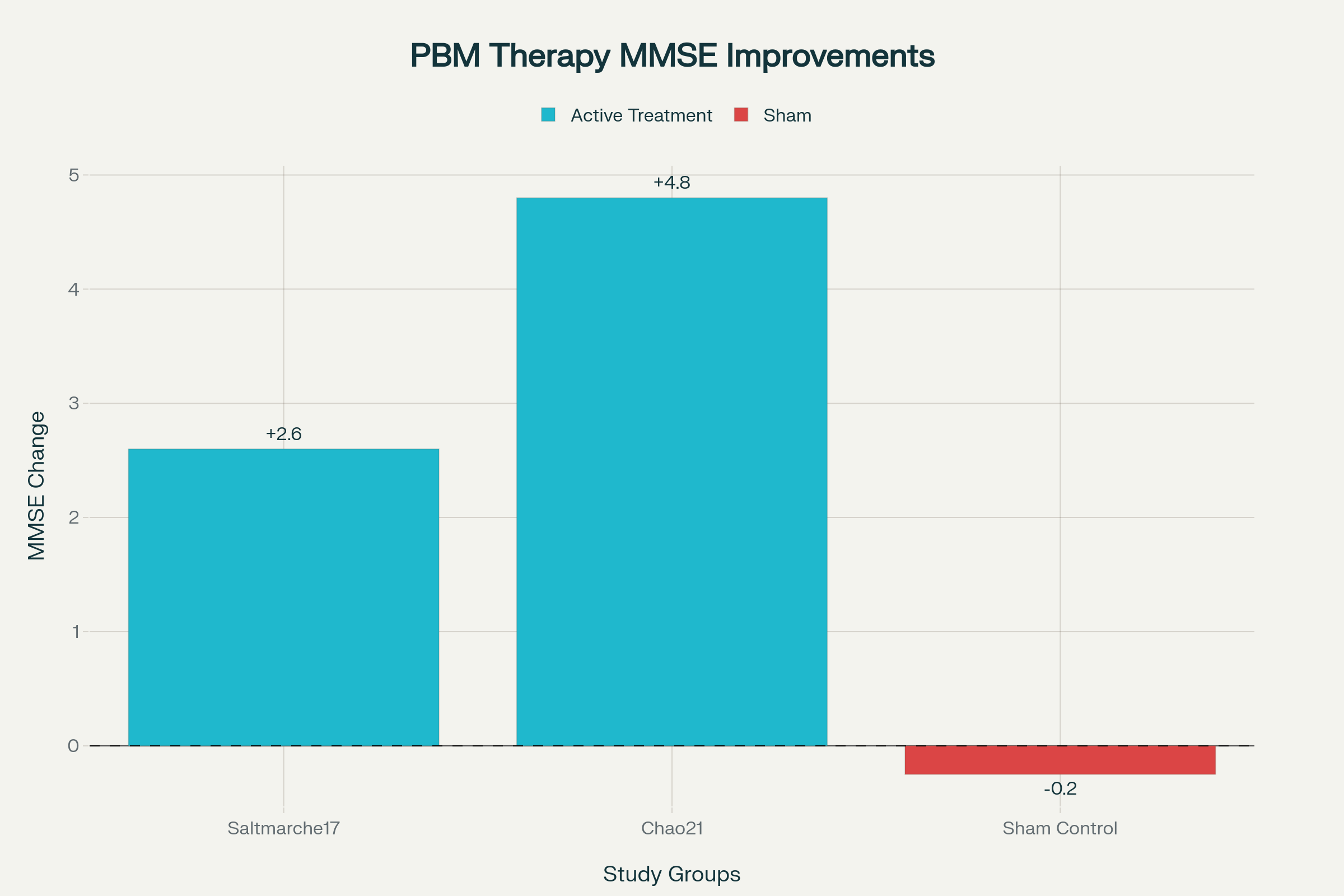
Results demonstrated significant improvement after 12 weeks with mean MMSE scores increasing by 2.6 points (p<0.003) and Alzheimer's Disease Assessment Scale-cognitive subscale (ADAS-cog) scores improving by 6.73 points (p<0.023). Quality of life improvements included better sleep, fewer angry outbursts, reduced anxiety and wandering, increased functional abilities, and decreased incontinence. Notably, during a 4-week no-treatment follow-up period, patients experienced precipitous cognitive declines, with one patient deteriorating so rapidly that ethical concerns necessitated resumption of treatment.
A subsequent larger randomized controlled trial by Chao and colleagues (2021) recruited 57 patients with dementia who underwent twice-daily 6-minute treatments for 8 consecutive weeks using 1060-1080 nm NIR light. This study reported even more substantial improvements: MMSE scores increased by an average of 4.8 points, with some individual patients demonstrating remarkable gains including one participant improving from MMSE of 16 to 28 (75% improvement). Logical Memory Tests improved by approximately 3 points, Trail Making Tests improved by 24%, Boston Naming Test improved by 9%, and Auditory Verbal Learning Tests showed improvements across all subcategories. Caregivers reported patients had improved mood, energy, and daily routines after 14-21 days of treatment.
Traumatic Brain Injury
Chronic traumatic brain injury represents another condition where photobiomodulation has shown clinical promise. An open-protocol pilot study by Naeser et al. (2014) examined 11 chronic mTBI participants (26-62 years of age) treated with LED clusters delivering red/NIR light (wavelengths not specified beyond "red and NIR") at 22.2 mW/cm² for 10 minutes to each of 11 scalp placements (13 J/cm² per site). Treatment consisted of 18 sessions over 6 weeks, with injuries ranging from 10 months to 8 years post-incident.
Neuropsychological testing revealed significant linear trends for improvement in executive function measured by the Stroop test Trial 3 inhibition (p=0.004) and Trial 4 inhibition switching (p=0.003), as well as memory improvements on the California Verbal Learning Test Total Trials 1-5 (p=0.003) and Long Delay Free Recall (p=0.006). Participants reported improved sleep and fewer PTSD symptoms, with family members noting better social, interpersonal, and occupational functioning.
More recent research has focused on the mechanisms underlying PBM's effectiveness in TBI, identifying antiapoptotic, anti-inflammatory, and pro-proliferative effects along with modulation of ferroptosis pathways. Studies demonstrate that PBM promotes neural progenitor cell proliferation, reduces cell death of both progenitor cells and immature neurons, and enhances the generation of mature neurons in peri-infarct regions. The therapy also reduces reactive gliogenesis while promoting oligodendrogenesis and preserving myelination.
Parkinson's Disease
A groundbreaking double-blind, randomized, sham-controlled feasibility trial led by Dr. Ann Liebert at the University of Sydney represented the first brain PBM trial to show positive clinical results for Parkinson's disease. Patients aged 59-85 years with idiopathic Parkinson's disease were treated with a tPBM helmet delivering red and infrared light for 24 minutes, 6 days per week for 12 weeks. Treatment was conducted in participants' homes and monitored via internet video conferencing.
The study assessed motor signs using a modified Movement Disorders Society Unified Parkinson's Disease Rating Scale (MDS-UPDRS) and demonstrated improvements in motor function, fine motor skills, balance, and cognition. Preclinical studies supporting these findings have shown that PBM at 670 nm and 810 nm reduces Parkinson's-like symptoms, prevents dopaminergic neuronal cell death, reduces gliosis, reduces oxidative stress, decreases TNF-α levels, and improves mobility and behavior in multiple animal models.
Mild Cognitive Impairment and Cognitive Enhancement
For individuals with mild cognitive impairment, a controlled study utilizing five sessions of tPBM at 850 nm LED to the right prefrontal cortex demonstrated beneficial effects on cognitive capacity and attentional performance in older women. The treatment produced both immediate and long-term improvements in cognitive function. In healthy adults, transcranial laser stimulation with 1064 nm light at 250 mW/cm² and 60 J/cm² has been shown to improve reaction times on psychomotor vigilance tasks, enhance memory retrieval latency and accuracy on delayed match-to-sample tasks, and improve self-reported positive affective states.
Functional neuroimaging studies have revealed that PBM enhances cognitive function through multiple mechanisms including increased cytochrome oxidase oxidation, elevated hemoglobin oxygenation, and modulation of brain electrical activity with increases in alpha, beta, and gamma wave power. These changes correlate with improved high-level cognitive functions including faster reaction times and enhanced performance on learning and memory retrieval tasks.
Depression and Anxiety
Transcranial photobiomodulation has emerged as a promising non-pharmacological intervention for major depressive disorder and generalized anxiety disorder. A systematic safety analysis of three clinical trials involving 80 individuals found that low-dose near-infrared tPBM can be administered safely with increasing frequency up to daily sessions for periods extending to 12 weeks without corresponding increases in adverse events. The most common side effects were mild and included headaches, perception of vivid colors, and irritability. One pilot study reported significant antidepressant effects after a single LLLT session to the forehead.
The mechanisms underlying PBM's effects on mood disorders involve modulation of brain monoamine neurotransmitters, enhancement of mitochondrial function in prefrontal regions associated with emotional regulation, and normalization of functional connectivity in dysregulated brain networks. Studies using 10 Hz pulsed wave delivery have observed antidepressant effects in both animal models and clinical populations.


-
Citations:
Henderson TA, Morries LD. Near-infrared photonic energy penetration: can infrared phototherapy effectively reach the human brain? Neuropsychiatr Dis Treat. 2015;11:2191-2208.
Morries LD, Cassano P, Henderson TA. Treatments for traumatic brain injury with emphasis on transcranial near-infrared laser phototherapy. Neuropsychiatr Dis Treat. 2015;11:2159-75.
Henderson TA, Morries LD. Multi-watt near-infrared phototherapy for the treatment of comorbid depression: An open-label single-arm study. Front Psychiatry. 2017;8:187.
Shen Q, Guo H, Yan Y. Photobiomodulation for neurodegenerative diseases: A scoping review. Int J Mol Sci. 2024;25:1625.
Moro C, Valverde A, Dole M, et al. The effect of photobiomodulation on the brain during wakefulness and sleep. Front Neurosci. 2022;16:942536.
Hamblin MR. Shining light on the head: Photobiomodulation for brain disorders. BBA Clin. 2016;6:113-124.
Lapchak PA, Boitano PD, Butte PV, et al. Transcranial near-infrared laser transmission (NILT) profiles: Systematic comparison in four common research species. PLoS ONE. 2015;10:e0127580.
Cassano P, Petrie SR, Hamblin MR, et al. Review of transcranial photobiomodulation for major depressive disorder: targeting brain metabolism, inflammation, oxidative stress, and neurogenesis. Neurophotonics. 2016;3:031404.
Tedford CE, DeLapp S, Jacques S, Anders J. Quantitative analysis of transcranial and intraparenchymal light penetration in human cadaver brain tissue. Lasers Surg Med. 2015;47:312-22.
Barrett DW, Gonzalez-Lima F. Transcranial infrared laser stimulation produces beneficial cognitive and emotional effects in humans. Neuroscience. 2013;230:13-23.
Salehpour F, Rasta SH, Mohaddes G, et al. Therapeutic effects of 10-Hz pulsed wave lasers in rat depression model: A comparison between near-infrared and red wavelengths. Lasers Surg Med. 2016;48:695-705.
Naeser MA, Zafonte R, Krengel MH, et al. Significant improvements in cognitive performance post-transcranial, red/near-infrared light-emitting diode treatments in chronic, mild traumatic brain injury: open-protocol study. J Neurotrauma. 2014;31:1008-17.
Xuan W, Agrawal T, Huang L, et al. Low-level laser therapy for traumatic brain injury in mice increases brain-derived neurotrophic factor (BDNF) and synaptogenesis. J Biophotonics. 2015;8:502-11.
Johnstone DM, Moro C, Stone J, et al. Turning on lights to stop neurodegeneration: The potential of near-infrared light therapy in Alzheimer's and Parkinson's disease. Front Neurosci. 2016;9:500.
Wang X, Tian F, Reddy DD, et al. Up-regulation of cerebral cytochrome-c-oxidase and hemodynamics by transcranial infrared laser stimulation: A broadband near-infrared spectroscopy study. J Cereb Blood Flow Metab. 2017;37:3789-3802.