

Chapter 2
IN THIS LESSON
Comparative Analysis of Therapeutic Wavelengths
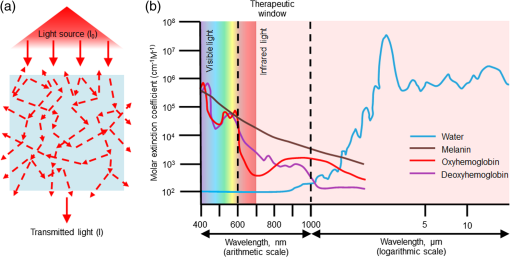
The selection of optimal wavelengths for transcranial brain stimulation requires balancing several factors including tissue penetration depth, chromophore absorption, and water content in biological tissues. The 810 nm wavelength has emerged as the gold standard for brain photobiomodulation based on multiple dosimetry studies demonstrating superior penetration and energy deposition across all age groups.
A landmark dosimetry study by Harvard Medical School's Department of Psychiatry compared multiple wavelengths and found that 810 nm consistently delivered the highest photon fluence to brain tissues, followed by 850 nm and 1064 nm. Critically, while longer wavelengths like 1064-1070 nm scatter less, they are significantly more absorbed by water molecules, which comprise 70-80% of brain tissue and surround the brain as cerebrospinal fluid. This increased water absorption beyond 950 nm substantially reduces the effective penetration depth despite the theoretical advantage of reduced scattering.
Human cadaver studies have demonstrated that 810 nm near-infrared light can penetrate approximately 40-50 mm through the scalp and skull, reaching cortical and some subcortical structures. The Vielight Neuro device, utilizing 810 nm wavelength at 250 mW/cm² irradiance, has been directly visualized penetrating through the calvaria of a human skull, validating the exceptional transcranial performance of this wavelength.
Mechanistic Differences Between Wavelengths
The cellular mechanisms activated by different wavelengths vary significantly. The 810 nm wavelength primarily acts through CCO-mediated mitochondrial signaling, producing downstream calcium influx and bioenergetic enhancement. In contrast, 1064-1070 nm wavelengths, while having reduced CCO interaction, more effectively activate heat/light-gated ion channels, particularly calcium channels (TRP channels). This produces water-mediated microheating effects that lead to membrane capacitance changes and calcium influx through alternative pathways.
For neurogenesis and cortical stimulation, 810 nm demonstrates considerable efficacy with strong anti-inflammatory effects and promotion of neural progenitor cell proliferation. The 670 nm wavelength, while showing good CCO absorption, has more limited penetration depth but has been extensively studied in neuroprotection experiments. Clinical applications have primarily employed 808-830 nm for transcranial protocols with treatment durations of 6-24 minutes.
-
Citations:
Henderson TA, Morries LD. Near-infrared photonic energy penetration: can infrared phototherapy effectively reach the human brain? Neuropsychiatr Dis Treat. 2015;11:2191-2208.
Morries LD, Cassano P, Henderson TA. Treatments for traumatic brain injury with emphasis on transcranial near-infrared laser phototherapy. Neuropsychiatr Dis Treat. 2015;11:2159-75.
Henderson TA, Morries LD. Multi-watt near-infrared phototherapy for the treatment of comorbid depression: An open-label single-arm study. Front Psychiatry. 2017;8:187.
Shen Q, Guo H, Yan Y. Photobiomodulation for neurodegenerative diseases: A scoping review. Int J Mol Sci. 2024;25:1625.
Moro C, Valverde A, Dole M, et al. The effect of photobiomodulation on the brain during wakefulness and sleep. Front Neurosci. 2022;16:942536.
Hamblin MR. Shining light on the head: Photobiomodulation for brain disorders. BBA Clin. 2016;6:113-124.
Lapchak PA, Boitano PD, Butte PV, et al. Transcranial near-infrared laser transmission (NILT) profiles: Systematic comparison in four common research species. PLoS ONE. 2015;10:e0127580.
Cassano P, Petrie SR, Hamblin MR, et al. Review of transcranial photobiomodulation for major depressive disorder: targeting brain metabolism, inflammation, oxidative stress, and neurogenesis. Neurophotonics. 2016;3:031404.
Tedford CE, DeLapp S, Jacques S, Anders J. Quantitative analysis of transcranial and intraparenchymal light penetration in human cadaver brain tissue. Lasers Surg Med. 2015;47:312-22.
Barrett DW, Gonzalez-Lima F. Transcranial infrared laser stimulation produces beneficial cognitive and emotional effects in humans. Neuroscience. 2013;230:13-23.
Salehpour F, Rasta SH, Mohaddes G, et al. Therapeutic effects of 10-Hz pulsed wave lasers in rat depression model: A comparison between near-infrared and red wavelengths. Lasers Surg Med. 2016;48:695-705.
Naeser MA, Zafonte R, Krengel MH, et al. Significant improvements in cognitive performance post-transcranial, red/near-infrared light-emitting diode treatments in chronic, mild traumatic brain injury: open-protocol study. J Neurotrauma. 2014;31:1008-17.
Xuan W, Agrawal T, Huang L, et al. Low-level laser therapy for traumatic brain injury in mice increases brain-derived neurotrophic factor (BDNF) and synaptogenesis. J Biophotonics. 2015;8:502-11.
Johnstone DM, Moro C, Stone J, et al. Turning on lights to stop neurodegeneration: The potential of near-infrared light therapy in Alzheimer's and Parkinson's disease. Front Neurosci. 2016;9:500.
Wang X, Tian F, Reddy DD, et al. Up-regulation of cerebral cytochrome-c-oxidase and hemodynamics by transcranial infrared laser stimulation: A broadband near-infrared spectroscopy study. J Cereb Blood Flow Metab. 2017;37:3789-3802.